
Home » Articles posted by sfrs_admin (Page 2)
Author Archives: sfrs_admin
Call for Nominations 2025
*Update: The positions have been filled in the meantime. We welcome Stefano Bottoni, Maria Bucur, Irina Livezeanu and Svetlana Suveica to the Board.
The SRS seeks nominations for the four positions on the Executive Board.
In order to qualify to be nominated for election to the Executive Board nominees must be
- a current member of SRS
- actively engaged in the field of Romanian Studies understood in the broadest sense
Please send nominations or self-nominations by July 11, 2025 to Roland Clark, Past President and Chair of the Nominating Committee, via e-mail clarkr@liverpool.ac.uk
The nomination should include a current email address and institutional affiliation, a 200-word bio, as well as a brief personal statement about your motivations and goals for the position you wish to stand for (up to 300 words). Please consult the SRS by-laws for details about SRS governance, available at https://society4romanianstudies.org/srs-bylaws/
Note: The Nominating Committee strives to promote balanced representation in regard to age, gender, professional background, country of residence, and geographical and disciplinary areas of specialization, but is not bound by anyparticular formula.
OPEN POSITIONS
Member x 4
Members of the Board have the duty to participate in Board meetings in person or online and exercise their right to vote on all aspects of the operation of the Society. Members will be called on to contribute to a range of activities of the Society including but not restricted to Prize Committees, Working Group activities, conference organisation, reviewing for the Journal of Romanian Studies.
SELECTION PROCESS
SRS elects Board members through an electronic ballot of all members in good standing. Open balloting will take place from July 16, 2025 and the results will be announced no later than August 1, 2025.
The nominating committee consists of:
Roland Clark, University of Liverpool, UK, clarkr@liverpool.ac.uk
Monica Ciobanu, State University of New York – Plattsburgh, USA, monica.ciobanu@plattsburgh.edu
László Fosztó, Romanian Institute for Research on National Minorities, Romania, laszlo.foszto@gmail.com
2024 Keith Hitchins Dissertation prize
Congratulations are in order for the winners of the second biennial Keith Hitchins Dissertation Prize: Keith Harrington (National University of Ireland, Maynooth) and George Andrei (Indiana University, Bloomington, USA).
In 2021 Professor Keith Hitchins passed away after retiring from a long and rich career at University of Illinois, Champaign-Urbana. Soon thereafter, the Society for Romanian Studies established a prize to honor his legacy for the study of Romania and Romanian related topics.
The selection committee comprised of Andrei Miroiu, Letiția Guran and Roland Clark unanimously decided to award the second biennial Keith Hitchins Prize for Best Dissertation in the field of Romanian Studies (academic years 2022-2023 and 2023-2024) to both Keith and George.
Keith Harrington, National University of Ireland, Maynooth: “Exploring the Internal Dynamics of the Transnistrian Separatist Movement, 1989-1992” (defended: September, 2023).
Keith Harrington’s doctoral dissertation provides a comprehensive and compelling overview of the Transnistrian separatist movement, focusing specifically on the contributions, disputes and voices of the rural population and of local Moldovan elites. This original and well-documented dissertation revisits the origin and evolution of the Transnistrian war, along with the emergence and dynamics of the Transnistrian Moldavian Republic in the context of Russia’s support for separatism in the region through a constant supply of free gas, subsidized pensions, humanitarian aid and assistance. While Harrington’s research is primarily focused on the creation of the T.M.R., it also provides valuable insights into the legacies and impact of competing nation-building projects, the rise and fall of pan-Romanian nationalism, the Gagauz separatist movement, and how open conflict was diffused in Moldova’s other Russian-speaking regions. It also develops a theoretical model for measuring resistance to secession that can be applied elsewhere. In the context of Russia’s 2022 invasion of Ukraine, which shares a border with Transnistria, Harrington’s study provides a scholarly reliable, much needed contextualization and understanding of the inter-ethnic conflicts and secessionist movements in the former Soviet republics.
George Andrei, Indiana University, Bloomington, USA: “Our Struggle for Existence: Negotiating Forestry, Rural Citizenship, and Statebuilding in Modern Romania” (defended: April 2024).
George Andrei’s dissertation makes an innovative contribution to understanding the modernization of Romania, and by extension, of Eastern Europe in terms of local socio-ecological systems by connecting the emergence of forestry in Romania to the rural state building accomplished by key local agents. Remarkably, the particular Transylvanian case studies he explores prove instrumental not only in interpreting past interactions between local communities and central state authorities, but in relating them to contemporary attempts to reconcile economic development and environmental justice to conservation and preservation efforts in and around some of Europe’s oldest forests. In the context of current environmental concerns, Andrei’s study joins cutting edge scholarly literature involved in redefining humans’ changing positionality and renewed responsibility toward nature in the age of the Anthropocene.
The SRS would like to thank the Selection Committee – Andrei, Letiția, and Roland – for their work and, of course, congratulate the winners!
Vol. 7 No. 1 (2025)
Journal of Romanian Studies, 7, No. 1 (2025)
Editors: Jill Massino, Narcis Tulbure
Book Review Editor: Iuliu Rațiu
Assistant Editor: Iemima Ploscariu
Contents
Jill Massino and Narcis Tulbure
(pp. 1-3 )
Articles:
Miruna Chirilă
Identities in Romania’s Post-Same-Sex Marriage Ban Referendum: Negotiating Queerness
(pp. 5–28)
This article examines discourses on queerness and the transformation of queer identities in Romania following the 2018 Referendum on the Same-Sex Marriage Constitutional Ban. Through interviews with queer individuals in Suceava and Galați, the research explores how queer people perceive their identities as political actors. The referendum marked a critical juncture in Romanian political culture, where conservative mobilization gained widespread support. In response, I argue that the expression of queer identities outside discourse from organizations (NGOs, politicians, political parties) has become more integral to activism in Romania. The interviews I conducted showed that since 2018, queer people have used self-expression (presenting as trans in public or working in artistic spaces) as a means of making anti-system statements and expressing their disapproval of both the political system and the strategies of queer NGOs. However, the potential to transform these practices into large-scale mobilization depends upon NGOs adapting the strategies of queer individuals. Thus, it is essential that NGO’s prioritize feedback from queer voices outside Bucharest, empower queer self-expression, and continue efforts to improve the quality of life for queer people in Romania.
Andrei Richter
(pp. 29–50)
This study highlights ongoing efforts by national government authorities and the public in Moldova to devise legal ways of countering propaganda disseminated by Russian and Belarusian media outlets, which are intent on manipulating public opinion and destabilizing Moldovan politics. The war in Ukraine has produced increased security risks for Moldova, which threaten the very existence of the nation. Concurrently, Moldova’s new status as a candidate state for EU membership, its lifting of the emergency rule as of 2024, and its renewed commitments to human rights and freedoms, including freedom of the press, require media monitoring authorities to be more attentive to both the European anti-propaganda toolbox, and European common values and principles.
Cristian Vasile
(pp.51–75)
Drawing on periodicals for dissemination abroad, historical sketches, museum catalogs, and academic journals, this historiographical essay examines scholarship produced during the communist and post-communist periods on some of Romania’s leading museums and art collections. Although scholars view the 1960s as a turning point in communist cultural policies, the historiography on museums and art collections suggests not just discontinuities, but also continuities; thus my aim is to analyze these ambiguities and complexities. Approaching the topic of museums and cultural heritage from a legislative standpoint is essential for understanding the delimitations in the historiographical milieu, as well as addressing the gap between legal norms and actual practices—a distinction often neglected by scholars. The current analysis extends into the post-communist period, examining the resilience of a state-oriented historiography about the recent history of Romania’s museums and art collections.
Source Translation:
Roland Clark
The Romanian Radical Right, 1924–1931
(pp. 77-102)
(pp. 103–116)
Georgi Georgiev
Luminita Gatejel, Engineering the Lower Danube: Technology and International Cooperation in an Imperial Borderland. Budapest-
Vienna-New York: Central European University Press, 2022. 331 pp.
Gabriel Ghirigan
Julieta Rotaru and David Gaunt. The Wallachian Gold-Washers: Unlocking the Golden Past of the Rudari Woodworkers. Brill: Leiden, 2023. 307 pp.
Sabrina Tosi Cambini. Other Borders: History, Mobility and Migration of Rudari Families Between Romania and Italy. New York: Berghahn Books, 2023. 248 pp.
Alex Drace-Francis
Costache Negruzzi, Mihail Kogălniceanu. 200 Proven Recipes for Dishes, Pastries and Other Household Works. English edition with commentary by Iurii Şvera. Milton Keynes: Ingram Consent Group, 2023. xii + 132 pp.
Ștefan Ionescu
Marius Turda, În Căutarea Românului Perfect: Specific național, degenerare rasială și selecție socială în România modernă [In Search of the Perfect Romanian: National Specificity, Racial Degeneration, and Social Selection in Modern Romania]. Iași: Polirom, 2024. 312 pp.
Vol. 6 No. 2 (2024)
Journal of Romanian Studies, 6, No. 2 (2024)
Editors: Jill Massino, Narcis Tulbure
Book Review Editor: Iuliu Rațiu
Assistant Editor: Iemima Ploscariu
Guest Editor: Maria Bucur
Contents
Introduction: The Legacies of Keith Hitchins for Romanian Historiography
Maria Bucur
(pp. 151–158)
Articles:
Paul E. Michelson
Revisiting Keith Hitchins’s Oxford History of the Romanians and Romania, 1774–1947
(pp. 159–176)
The purpose of the article is to revisit, after a quarter of a century, Professor Keith Hitchins’s two-volume Oxford synthesis of Romanian history from 1774 to 1947. It summarizes his principal premises and conclusions and then assesses how well his findings have held up since then.
Radu Nedici
(pp. 177–195)
This article attempts an assessment of Keith Hitchins’s legacy on the question of the intellectual origins and development of the Romanian nation in Transylvania from the late eighteenth to the early twentieth century. I focus on how his works have been read by scholars of different generations in Romania, mostly through an analysis of the reviews his books received in both scientific journals and the popular press. Closely linked to the political context of the 1960s–70s and after 1989, I suggest his success in Romanian academia rested mainly on him being perceived as a foreigner who was able to write truthfully about one of Romania’s most intimate historical topics. It is my contention that the consequence has been a lack of critical engagement with Hitchins’s idea of nation, which led to a failure to assimilate the implicit constructivist approach at the core of his investigation.
Anca Șincan
Positive Influence: Negotiating a Church Historiographical Canon with the West
(pp.197–216)
The present article discusses the way in which the historiographical canon on the history of the Orthodox and Greek Catholic Churches in Transylvania during the eighteenth and nineteenth centuries was reconceptualized during and in the aftermath of the academic visit of Western specialists in Romania. Keith Hitchins’s visit to Romania in the early 1970s to undertake research in the church archives for his work on the history of the Romanian intelligentsia in the Austro-Hungarian Empire made an impact on how the history of the Greek Catholic Church was portrayed in the religious journals of the Romanian Orthodox Church. The subtle shifts in the canon included distinguishing the Greek Catholics from the Orthodox in Transylvania and reintroducing the Greek Catholic interwar historiography into the interpretation.
Alex R. Tipei
(pp. 217–237)
This article discusses the tension created in Keith Hitchins’s work between his constructivist approach to the nation and his adherence to a certain type of methodological nationalism. Examining Hitchins’s The Romanians, 1774–1866 through the lens of his pedagogy, the article posits that his commitment to methodological nationalism and his use of language associated with this approach obscured his understated argument on the constructed nature of Romanian national identity. It explores the impact of Hitchins’s scholarship and teaching on my own research to show why moving beyond the language of methodological nationalism is important and offers suggestions for doing so.
(pp. 239–249)
Dumitru Lisnic
Eugen Străuțiu, Steven D. Roper, William E. Crowther, Dareg Zabarah-Chulak, Victor Juc, and Robert E. Hamilton (Editors). The Armed Conflict of the Dniester. Three Decades Later. New York: Peter Lang, 2023. 251 pp.
Paul E. Michelson
Vasile Pușcaș. Keith Hitchins: The Historian’s Honesty/Onestitate istoricului. Cluj-Napoca: Editura Școala Ardeleană, 2021. 169 pp.
Gheorghe Gelu Păcurar
Marco Guglielmi. The Romanian Orthodox Diaspora in Italy: Eastern Orthodoxy in a Western European Country. Cham: Palgrave Macmillan, 2022. xv + 170pp.
Dumitru-Cornel Vîlcu
Johannes Kabatek, Eugenio Coseriu: Beyond Structuralism. Berlin: Walter de Gruyter GmbH, 2023. 326 pp.
Valentina Glajar, Dosarul de Securitate al Hertei Müller. O poveste din arhive despre supravegherea din România comunistă, cuvânt înainte de Alison Lewis, trad. Alina Pavelescu (2025)

[the English-language edition, The Secret Police Dossier of Herta Müller: A “File Story” of Cold War Surveillance, was awarded the 2025 George Blazyca Prizeof the British Association for Slavonic and East European Studies]
This book is an in-depth investigation of Müller’s file, and engages with other related files, including that of her then-husband, the writer Richard Wagner. Valentina Glajar treats the files as primary sources in order to re-create the story of Müller’s surveillance by the Securitate. In such an intrusive culture of surveillance, surviving the system often meant a certain degree of entanglement: for victims, collaborators, and implicated subjects alike. Veiled in secrecy for decades, these compelling and complex documents shed light on a boundary between victims and perpetrators as porous as the Iron Curtain itself.
(From Boydell and Brewer’s webpage)
What people say about it:
“The Secret Police Dossier of Herta Müller shows in fine detail how the Securitate infiltrated the lives of so many people. SECU included SECU officers, SECU informers, SECU translators, and SECU targets, or ‘privileged targets,’ who were able to travel abroad, bring back books published in the West, meet with foreigners, publish their books in the West, earn royalties in foreign currency – in part because of their willingness to cooperate with SECU. Were they just another version of the “sources” who informed on them? The ambiguity of the relationships of those caught up in the SECU network is striking. It was a slippery slope on which even Müller and her husband, the writer Richard Wagner found themselves for a while.” (Irina Livezeanu, University of Pittsburgh)
“The book illuminates the Romanian surveillance apparatus, revealing how targets, informers, and bystanders came to be (voluntarily or not) entangled with the Securitate, and also throws light on the complex lives of the German ethnic minority in communist Romania. The richness and interdisciplinary character of Glajar’s work make it equally appealing to surveillance studies scholars, Cold War historians, and Romanian and German studies specialists. Moreover, Glajar’s monograph stands out through its engaging tone, clear prose, and well-devised narrative arc. The reader often feels they are following a gripping story in which incisive, well-balanced analyses are combined with exciting details about twists and turns in the Securitate’s moves and Müller’s and the informers’ lives and decisions. To sum up, Glajar’s solid academic endeavor is an exciting read for both scholarly audiences and the general public.” (Ioana Luca, National Taiwan Normal University, in Journal of Romanian Studies)
“A Securitate file is a strange document, part fact, part malevolent ideological fiction, and as full of holes as a sieve. It reveals as much, if not more, about its creators and the system they served as it does about the man or woman unlucky enough to be its subject. Contextualizing and making sense of it is no easy task. Glajar embeds her research within the wider context of postcommunism while also bringing out the country-specific features of Müller’s file story.“ (Brigid Haines, Swansea University, in Seminar: A Journal of Germanic Studies)
“Readers of this engaging, clear, and precise scholarly monograph will be left with several insights that open unique and previously unconsidered perspectives on Müller’s work and in the Müller scholarship. […] the book represents a paradigm shift in the scholarship on Herta Müller in that, rather than reading the secret police files as a lens through which to analyze Müller’s texts, it reads the surveillance files as “file stories.” Scholars of Müller’s work, students at the undergraduate and graduate levels, and general audiences interested in memory studies, reading and uncoding archived Cold War surveillance files, and Cold War surveillance tactics in the communist Romanian context, will find a treasure trove in this monograph.” (Maria S. Greve, City University of New York, in Gegenwartsliteratur)
„This book has all the earmarks of a police procedural or whodunit. Reading it, one feels that one is in the midst of a film about the secret police on the order of Florian Henckel von Donnersmarck’s 2006 Das Leben der Anderen. Whereas von Donnersmarck’s film is entirely fictional, however, Glajar’s book is based on all-too-bitter reality: the actual secret police dossier put together in the 1980s by the Romanian Securitate on Herta Müller, the most celebrated of her generation of Romanian-German writers.“ (Stephen Brockmann, Carnegie Mellon University, in Monatshefte)
„Overall, this is both a gripping account of surveillance and a model for how to build accessible and insightful analysis out of secret police archives. Glajar makes a sprawling and obscure written record graspable and interesting to her reader without accepting it at face value, and has therefore produced a study that will have an appeal far beyond the academic community interested in Müller.
However, it is the implicit evaluation of Müller’s honesty that forms the red thread in this book, and that is likely to attract the most attention.“ (Jenny Watson, University of Edinburgh, in Oxford German Studies)
You can listen to interviews with the author here (in English) and here (in Romanian).
You can read a preview of the book here.
You can buy the book here.
About the author:
Valentina Glajar is Professor of German at Texas State University.
You can find more information about Valentina Glajar here.
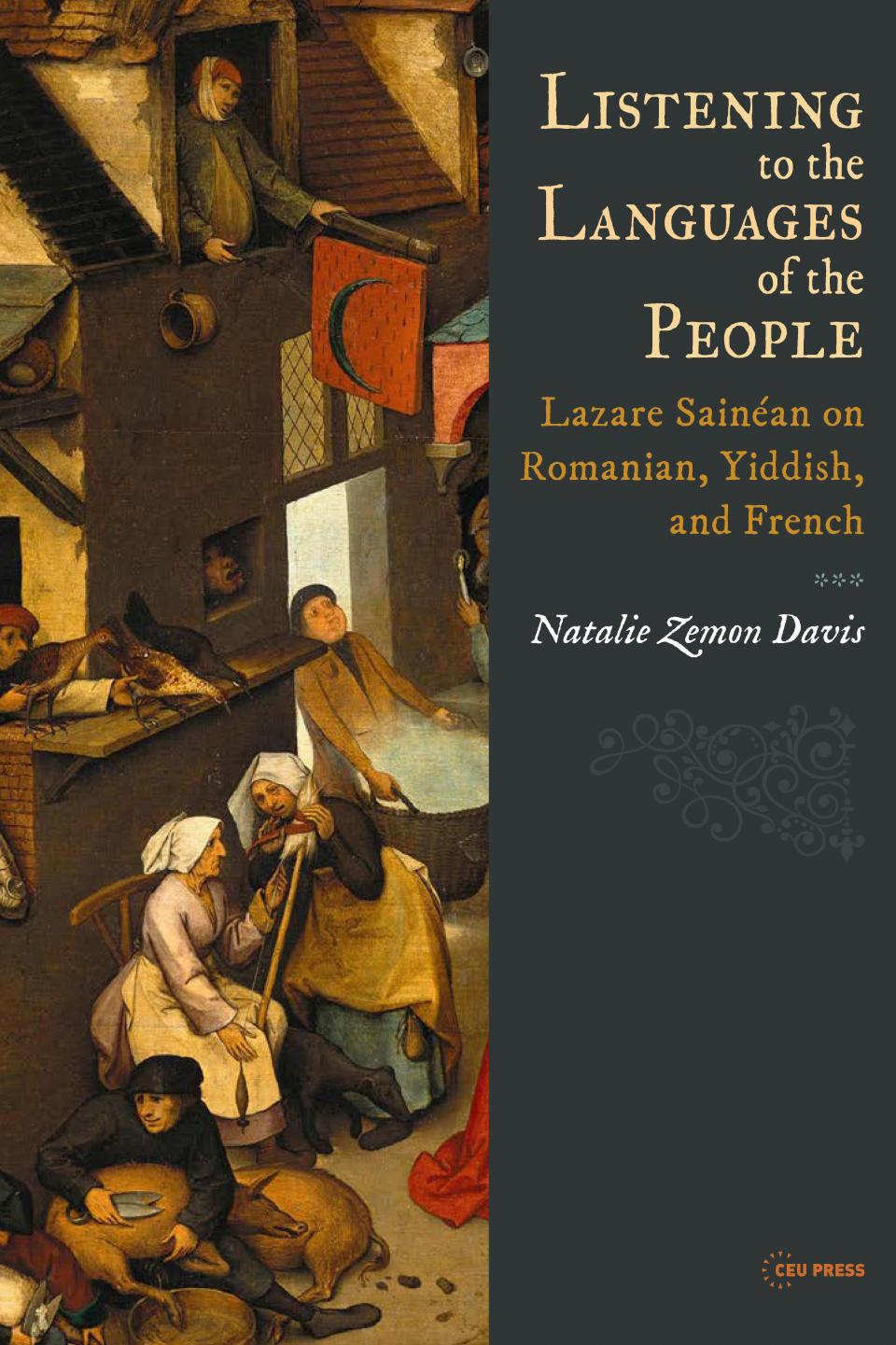
Natalie Zemon Davis, Listening to the Languages of the People: Lazare Sainéan on Romanian, Yiddish, and French. Budapest, Vienna, New York: CEU Press, 2022.
Book under preparation in SRS’s Polirom series
(The Romanian translation will be published with the support of the “Elie Wiesel” National Institute for the Study of the Holocaust in Romania)
This tale of great achievements and great disappointments offers a fresh perspective on the interplay between scholarship and political sentiment in the late nineteenth and early twentieth centuries. (From the webpage of CEU Press)
“Once again, Natalie Zemon Davis has given us a beautifully written and meticulously researched study illuminating a historical period through the story of one individual. Lazare Sainean (1859–1934)—philologist, folklorist, Jew, convert, scholar of Rumanian, French, and Yiddish—was repeatedly denied citizenship and academic positions and yet, as Zemon Davis convincingly argues, was able to cross cultural and geographic boundaries.” (Anita Norich, University of Michigan)
“Romania has been on the fringes of Yiddish research until now. A new book by Natalie Zemon Davis shows that one of the very first studies of Jewish dialects was published in Romania at the end of the 19th century. Her book “Listening to the languages of the people: Lazar Sainean on Romanian, Yiddish, and French” tells the dramatic life story of an important Romanian philologist of Jewish origin, who made an important contribution to Jewish linguistics.” (translated from Yiddish) (Michael Krutikov, University of Michigan, in Forward)
“In her last book, Natalie Zemon Davis takes on the multifaceted life of a linguist and philologist born in Romania, who died in Paris, as a window into the survival strategy of Jewish intellectuals in the face of antisemitism in Europe at the end of the nineteenth century. In her well-honed technique of biographical inquiry and storytelling, she brings to life the aspirations and disappointments, the passion and sorrow of someone who deserved better than he got. That is the perspective Zemon Davis presents in this empathetic portrait of Eliezer ben Moses Șain, later Lazar Șăineanu, and finally Lazare Sainéan in the last decades of his life.” (Maria Bucur, Indiana University, in Hungarian Studies Review)
“This book is the final intellectual legacy of the renowned historian Natalie Zemon Davis (1928-2023), often identified as a pioneer of microhistory. Zemon Davis’s latest publication reaffirms her exceptional talent for storytelling expressed in the masterly treatment of figures with complex and elusive identities.” (Nicola Perencin, University of Padova, in Journal of Modern Jewish Studies)
“A very important contribution to the study of the history of the Yiddish, Romanian, and French linguistics, of Romanian and general East European and Balkanic folklore, and of the history of the Jews of Romania in the period of the polemics for emancipation in the last two decades of the 19th century. The book is very useful for philologists, folklorists, historians of Romanian Jewry and of Romania.” (Lucian-Zeev Herșcovici)
“Known under the name of Lazăr Șăin, Lazăr Șăineanu (from 1883) and Lazare Sainéan (from 1901), the renowned linguist and folklorist is an interesting addition to Natalie Zemon Davis’s study of figures who crossed cultural and geographical boundaries. This book, which often reads like a novel, emphasizing the author’s qualities as a storyteller, follows one man’s destiny in late nineteenth-century Europe, as one of many Jewish life stories. The book explores identity as constructed by its subject, but also as recast by the historian.” (Maria Silvia Crăciun, Babeș-Bolyai University)
“Davis quotes Sainéan’s own assessment of his situation at the end of his long career: ‘indeed, here, in regard to social relations, I am always still ‘the intruder’. One of the virtues of her book is that she does not seek to hide her subject’s foibles—including a somewhat thin-skinned insistence on his own rightness, a certain defiant self-regard, a pragmatism that didn’t always do him much good. Rather, Davis goes constantly in search of more complex motives behind Sainéan’s scholarly preoccupations and life choices: this renders us a very human figure, whose story serves as a litmus for the atmosphere of the times through which he lived.” (Alex Drace-Francis, University of Amsterdam, in Reviews in History)
“’My life was crossed by so many disappointments’ declared Lazare Sainéan. In a book written with erudite empathy, Natalie Zemon Davis reconstructs the successive disappointments of this extraordinary scholar. Her rigorous and touching work allows us to listen the vigorous and tormented voice of a man who dedicated his intellectual life to encounters, loved two nations and three languages, and, however, remained everywhere a foreigner.” (Roger Chartier, Collège de France and University of Pennsylvania)
“The tragic biography of Lazar Sainéan (1859–1934), entangling different beliefs (Judaism, Christianity, and atheism), different lands (mainly Romania and France) and most importantly, different languages, was recently turned by leading historian Natalie Zemon Davis into a thrilling topic. In yet another impressive global-microhistorical exploration, and once again loyal to the Italian “exceptional normal” tradition she has sparked in the US, Davis uses Sainéan’s account to ponder about the shaping of different social hierarchies from a Jewish perspective.” (Guli Dolev-Hashiloni, Free University Berlin, in H-Soz-Kult)
“There are many gaps and unknowns in Sainéan’s biography, as the linguist wrote only a short memoir and left no personal papers. Either by reconstructing the linguist’s social networks or by tracing his intellectual influences, Zemon Davis fills the blank spaces with great accuracy and helps us understand how transfer of ideas and Sainéan’s reflection on identity and sense of belonging evolved. This way Zemon Davis manages to write a biography that can serve as a starting point for the research of modern Jewish history in Romania and beyond.” (Andreea Kaltenbrunner, University of Regensburg, in Quest. Issues in Contemporary Jewish History)
About the author:
Natalie Zemon Davis (1928–2023) was the Henry Charles Lea Professor of History emeritus at Princeton University, where she also served as Director of the Shelby Cullom Davis Center for Historical Studies, and was also Adjunct Professor of History at the University of Toronto. She taught earlier at the University of Toronto and at the University of California at Berkeley. A social and cultural historian of early modern times, she is the author of 200 articles and of nine books, with many of them translated into several foreign languages.
You can find more information about Natalie Zemon Davis here.
Society for Romanian Studies The Sixteenth Annual Graduate Student Essay Prize
The Sixteenth Annual Graduate Student Essay Prize 2024 is awarded to Miruna Chirila, MA in Russian and Post-Soviet Politics at University College London, for her essay, “Identities in Romania Post-Same Sex Marriage Ban Referendum: Negotiating Queerness.” The panel praised the essay as a well-written and fascinating exploration of the impact of the 2018 same-sex marriage referendum on both discourses of queerness and self-representation among individuals in Moldavia. In her well-argued approach, Chirila focuses on individual queer voices and their acts of resistance and non-compliance in the face of the conservative mobilization of the Orthodox Church and political parties that, in turn, prompted a more assertive embrace of queer and trans identities.
Valentina Glajar
Petru Negură
Delia Popescu
Vol. 6 No. 1 (2024)
Journal of Romanian Studies, 6, No. 1 (2024)
Editors: Jill Massino, Narcis Tulbure Book Review Editor: Iuliu Rațiu Assistant Editor: Iemima Ploscariu
Contents
Jill Massino, Narcis Tulbure (pp. 1-4)
Articles:
Eduard Baidaus
(pp. 5-26)
This article examines the fate of Soviet refugees who fled collectivization and the famine by focusing on the residents of the Moldavian Autonomous Soviet Socialist Republic (MASSR) who attempted to cross the Soviet–Romanian frontier during the late 1920s–early 1930s. The article discusses their lives in the USSR prior to their flight, their perilous journey across the border, and their experiences in Romania.
Răzvan Roşu
Beyond Nationalism and State Authorities: Voices of the Moți Colonists from the Carei Area
(pp. 27-45)
Following the creation of Greater Romania and the Hungarian–Romanian War in 1919, the Romanian state decided to colonize the new Hungarian–Romanian border with ethnic Romanians. Among other ethnic Romanians from the Apuseni Mountains and Maramureș, the authorities considered the Moți the most suitable settlers. This article examines this process by focusing on the Moți colonies in the Carei region, situated in northwestern Romania. In contrast to most research on the topic, which has relied exclusively on written sources from archives and newspapers, examining colonization from the perspective of state authorities, this article explores the topic from the perspective of the settlers themselves. Drawing on oral histories with the Moţi, it examines the challenges they faced in adapting to their new environment, their relationships with other ethnic groups, and their negotiations with state authorities. By analyzing oral sources alongside official and elite sources, it provides a more nuanced portrait of colonization that showcases the voices of ordinary people.
Bronwyn Cragg
Letters from Exile: Canadian Media, the Romanian Diaspora, and the Legionary Movement
(pp.47–70)
This article traces the post-Second World War immigration of Romanians to Canada, and addresses themes of self-identification versus outside perception, national identity, and myth-making in the Romanian-Canadian community. It subsequently documents the scrutiny faced by the Romanian diaspora for supposed links to the interwar Romanian far-right Legionary Movement. Beginning in the 1950s, Romanian exiles in Canada forged their own community organizations, churches, and media, in which a unique synthesis of national identity and far-right politics was promoted, placing these new immigrants at the center of intracommunity and inter-ethnic conflict. Following the release of the Deschênes Report on war criminals living in Canada in 1986, as well as a series of unsolved terrorist attacks, Romanian-Canadians were subject to investigations by the mainstream Canadian media for potential involvement in far-right organizing. In the years since the collapse of state socialism in Eastern Europe, significant strands of the Romanian diaspora in Canada have continued to embrace historical figures of the Legionary Movement, synthesizing a diaspora identity flavored by anticommunism, radical right politics, and (ultra-) nationalism well into the post-communist period.
Keith Harrington
(pp.71–94)
The Popular Front of Moldova (PFM) was a sociopolitical movement in the Moldavian Soviet Socialist Republic that spearheaded several initiatives that helped dismantle Soviet power in Moldova. However, the group’s pan-Romanian position created deep divisions within Moldovan society. Drawing on extensive archival research, this article explores how local branches of the PFM, officially known as coordination committees, sought to reshape local politics between 1989–1992. I examine the composition of these coordination committees, their policy initiatives, and their relationship with local authorities, which varied according to geographic and demographic factors. I argue that the group’s hard-line position eventually caused it to lose support across Moldova, including in regions where the PFM had initially been immensely popular.
Mihai S. Rusu
(pp.95–121)
Besides being canonized as Romania’s “national poet,” Mihai Eminescu was hailed as the “complete man of Romanian culture” and the “absolute Romanian,” among a profusion of
encomiastic praises. Eminescu was immortalized in myriads of ways, from the most solemn and official (e.g. state-run rituals) to the most prosaic and banal (e.g. banknotes). In this article, I investigate the spatial dimension of Eminescu’s memory by charting the commemorative landscape defined by toponymy and public monuments honoring the national poet in Romania. Particular attention is given to Eminescu’s presence in urban street nomenclature and its regional distribution across the country. Drawing on several datasets of spatial information, I use statistical modeling techniques to examine the factors underpinning Eminescu’s memorial namescape. Employing logistic regression analyses, the article highlights an uneven geography of Eminescu’s memory and points out the variables structuring its particular spatial patterning.
Source Translation:
Dumitru Lisnic and James A. Kapaló
(pp. 231–241)
Vladimir Solonari
Philippe Henri Blasen. La “primauté de la nation roumaine” et les “étrangers”: Les minorités et leur liberté du travail sous le cabinet Goga et la dictature royale. Cluj-Napoca: Casa Cărţii de Ştiinţă, 2022. 408 pp.
Gheorghe Gelu Păcurar
Oliver Jens Schmitt. Biserica de stat sau Biserica în stat? O istorie a Bisericii Ortodoxe Române: 1918–2023. București: Humanitas, 2023. 457 pp.
Simona Drăgan
Annemarie Sorescu-Marinković, Mihai Dragnea, Thede Kahl, Blagovest Njagulov, Donald L. Dyer, and Angelo Costanzo, eds. The Romance-Speaking Balkans: Language and the Politics of Identity. London: Brill, 2021. 260 pp.
Andrei Cușco
Svetlana Suveica. Post-Imperial Encounters: Transnational Designs of Bessarabia in Paris and Elsewhere, 1917–1922. Berlin: De Gruyter Oldenbourg, 2022 (Südosteuropäiche Arbeiten, 167). 509 pp.
Roland Clark
Dorina Dragnea, Emmanouil Ger Varvounis, Evelyn Reuter, Petko Hristov, and Susan Sorek, eds. Pilgrimage in the Christian Balkan World: The Path to Touch the Sacred and Holy. Turnhout: Brepols, 2023. 300 pp.
Mihaela Șerban, Subverting Communism in Romania: Law and Private Property 1945-1965. Lanham: Lexington Books, 2019
Book under preparation in SRS’s Polirom series

“Subverting Communism in Romania explores the role of law in everyday life and as a mechanism for social change during early communism in Romania. Mihaela Șerban focuses on the regime’s attempts to extinguish private property in housing through housing nationalization and expropriation. This study of early communist law illustrates that law is never just an instrument of state power, particularly over the long term and from a ground-up perspective. Even during its most totalitarian phase, communist law enjoyed a certain level of autonomy at the most granular level and consequently was simultaneously a space of state power and resistance to power.” (From Rowman & Littlefield’s webpage)
“Mihaela Şerban makes a compelling argument that communist legality in socialist East and Central Europe should be equally understood as an instrument of state repression and a space for continuity, accommodation, and subversion. This argument is sustained by a rich documentation of historical and archival sources and interviews relating to the nationalization and expropriation of housing in the Banat region of Romania during the first two decades of the communist regime between 1945-1965. […] The monograph has broader implications for the complex relationships between any legal system and its subjects in a non-democratic society. Its sophisticated conceptual approach makes it an important source for a large academic audience including scholars of socialism and post-socialism, of law and society and of transitional justice.” (Monica Ciobanu, State University of New York at Plattsburgh)
”Mihaela Șerban argues that the nationalization of urban housing in early communist Romania offers a unique view into the strategies deployed by the new communist regime to consolidate its power. Drawing on a rich collection of archival material, which Șerban discovered in the regional archives of Timișoara in western Romania, the book tells a very important story. This is a story of negotiation of power, capital, and the economic and symbolic value of houses as a particular form of property. Șerban draws on a wide range of theories as well as meticulous research, grounded in a critical reading of the laws dealing with nationalization, as well as a vast collection of case studies, revealing an incredible array of life histories captured by hundreds of petitions. She offers us not only a sharp and very well-written history of the uses and abuses of law in early communist Romania, but also the most detailed and theoretically sophisticated account of the nationalization process in Romania (published so far).” (Emanuela Grama, Carnegie Mellon University)
“Șerban tells an unexpected and previously unknown story of resistance to the nationalization of their homes by ordinary Romanians in the 1950s. She weaves her meticulous archival research into an engaging and theoretically compelling narrative of the ups and downs of the campaign to reshape legal consciousness in the image of Marxism-Leninism. The endless petitions by displaced Romanians to have their rights reinstated demonstrate not only that law mattered, but also their continued belief in private property. Serban’s book fills a nagging gap in the literature and deserves to be widely read.“ (Kathryn Hendley, University of Wisconsin)
”In this six-chapter book, Mihaela Serban offers a nuanced perspective of the manifold ways in which legal continuity and change affected the takings of homes during early communist rule in Romania. With the help of newly discovered archival documents she studied in Timişoara, Serban shows that during the 1945-1965 period law was more than an instrument of violence and repression blindly used by a dictatorial regime to effect social change and unmake the pre-communist hegemony of private property. […] A carefully researched and elegantly written analysis showing profound understanding of Romanian realities, this book is a necessary reading for all those interested to know more about the property regime, the legal culture, and the interplay between power and law in an understudied country of the former communist bloc.” (Lavinia Stan, St. Francis Xavier University)
About the author:
Mihaela Şerban is Professor of Law and Society at Ramapo College of New Jersey. She joined Ramapo College after earning law and graduate degrees from the University of Bucharest (Romania), Central European University (Budapest, Hungary), and New York University, and working for the Ford Foundation and the New York University School of Law. As a multi-disciplinary scholar, she focuses on the complex nature of law in society, the way it is both shaped by and itself shapes society. Her teaching and publications are in the areas of law and society, human rights, the rule of law, and memory studies. Her most recent publications include “Law as Mnemonic Infrastructure: Archival Legal Discourses and Memory Battles in Romania,” in the Journal of Law, Culture and the Humanities (2024), and “Are We There Yet? Romania’s Semi-Peripheral Rule of Law,” in Lavinia Stan and Diane Vancea (eds.), Post-Communist Progress and Stagnation at 35: The Case of Romania (Palgrave Macmillan, 2024). She is currently co-editing a volume, with Monica Ciobanu, entitled Between the Memory and Post-Memory of Communism in Romania: Fluid Memories (Routledge, forthcoming).
You can find more information about Mihaela Șerban here.
Giuseppe Tateo, Sub semnul crucii. Catedrala Mântuirii Neamului şi construcţia de biserici în România postsocialistă. Iași: Polirom, 2024.

Translation by Maria-Magdalena Anghelescu
Foreword by Simion Pop
Based on extensive ethnographic research, this book delves into the thriving industry of religious infrastructure in Romania, where 4,000 Orthodox churches and cathedrals have been built in three decades. Following the construction of the world’s highest Orthodox cathedral in Bucharest, the book brings together sociological and anthropological scholarship on eastern Christianity, secularization, urban change and nationalism. Reading postsocialism through the prism of religious change, the author argues that the emergence of political, entrepreneurial and intellectual figures after 1990 has happened ‘under the sign of the cross’. (From the webpage of Berghahn Books)
What people are saying about it:
“The result of careful and in-depth research, also enriched by interesting references to the history of the Romanian intellectual classes, the volume brings into dialogue theories and instruments of the international debate with local sources and research. The work also confirms the ethnographic validity of an observation centered on the material infrastructure and on the exploration of the social, economic and symbolic networks connected to it; it thus offers a polyphonic representation of the importance – also economic, monumental and ideological – that Orthodox Christianity assumes in the new public space, while speaking at the same time about the arrangements and orderings that allow religious actors to manipulate and construct it.” (Davide Carnevale, ANUAC. Rivista della società italiana di antropologia culturale) [original review in Italian]
“Drawing upon detailed ethnographical research, leavened with an impressive command of theoretical literature on the social life of architecture and urban special symbolism, the author examines the development of religious infrastructure in Romania, where four thousand Orthodox churches have been constructed over the three decades since the revolution. At the same time, Tateo’s book offers an analysis of secularization and urban change, and their impact upon the course of nationalism in the country.” (Dennis Deletant, Slavonic and East European Review)
“There is much to like in Tateo’s analysis. Throughout this book he uses stories and case studies to illuminate the broader relationships between the state and the Orthodox Church in Romania, at both national and local levels. He also demonstrates persuasively that to understand the role and importance of religion in a postsocialist context it is necessary to move beyond explanations grounded in religious revivalism, and consider the range of actors with diverse political and economic interests which intertwine to shape the religious landscape.“ (Duncan Light, Eurasian Geography and Economics)
“Giuseppe Tateo’s book is an important contribution to the recent history of the Romanian Orthodox Church and its current crisis in a slowly secularizing Romania. […] Combining the sociology of religion, space theory, cultural anthropology, and church history, Tateo’s book serves as an important example of a transdisciplinary approach in the academic study of religions in Central-Eastern Europe.” (Csaba Szabó, Religion and Society in Central and Eastern Europe)
You can listen to interviews with the author here and here.
You can buy the book here.
About the author:
Giuseppe Tateo is postdoctoral fellow at the Research Institute of the University of Bucharest and researcher at the Bruno Kessler Foundation (Trento, Italy). After earning his PhD from the Max Planck Institute for Social Anthropology (Halle), he taught at Charles University (Prague) and at Riga Stradins University, and he was a postdoctoral researcher in Bucharest, Prague and Leipzig. His current research interests focus on the link between political authority and religious architecture in post-socialist Europe with a specific focus on Romania.