
Home » Books under preparation
Iemima Ploscariu,Alternative Evangelicals: Challenging Nationalism in Interwar Romania’s Multi-ethnic Borderlands. Paderborn: Brill Schöningh, 2024.
Book under preparation in SRS’s Polirom series

“Finally a book on Romanian history that unpacks the day to day experiences of ordinary people and how they built churches and communities. Ploscariu tells her stories through the voices and experiences of individuals from ethnic and religious minorities, showing us how they saw their world, not just what the authorities thought about them. This book complicates Romanian religious history in wonderful and surprising ways. It will be the definitive work on the subject for many years to come.” (Roland Clark, University of Liverpool)
“This book contributes significantly to our understanding of the social and religious history of interwar Romania and to the transnational evangelical expansion of the era.” (Heather Coleman, University of Alberta)
“Here is a masterful reconstruction of the everyday life of evangelical communities in interwar Romania and their members’ intricate personal relationships. This excellent study is a must-read for any scholar of nationalism who wants to understand how diverse religious and ethnic minorities struggled and thrived in a nationalising European state.” (Maria Falina, Utrecht University)
“Alternative Evangelicals is a captivating book which opens up important innovative perspectives on the Evangelical communities in interwar Romania. […] Iemima Ploscariu delivers a superb and compelling account of how these groups managed to navigate the rising tide of nationalism in interwar Romania, while also challenging it through their ethnically, linguistically and socially diverse congregations.” (Iuliana Cindrea-Nagy in Review of Ecumenical Studies)
“Alternative Evangelicals is an essential read for those seeking to understand the history of evangelicals in Romania’s diverse regions, and a religious group that navigated the complexities of a deeply nationalist and predominantly Orthodox society.” (Alexandru Profiri in Journal of Romanian Studies)
About the author:
Iemima Ploscariu is managing editor for East-Central Europe at the Directory of Open Access Journals (doaj.org) and editorial assistant for Liverpool University Press’s the Journal of Romanian Studies. She received her PhD in History from Dublin City University in Ireland. She also holds a MA in Comparative History from Central European University (Budapest) and a MLitt in Central and East European Studies from the University of St Andrews (Scotland). Her previous publications include research on ethnic and religious minorities, nationalism, music, the Holocaust, memory, and gender in twentieth-century Romania. She is based in Sacramento, California. You can read here an article by Iemima Ploscariu and listen to an interview in which she discusses her book.
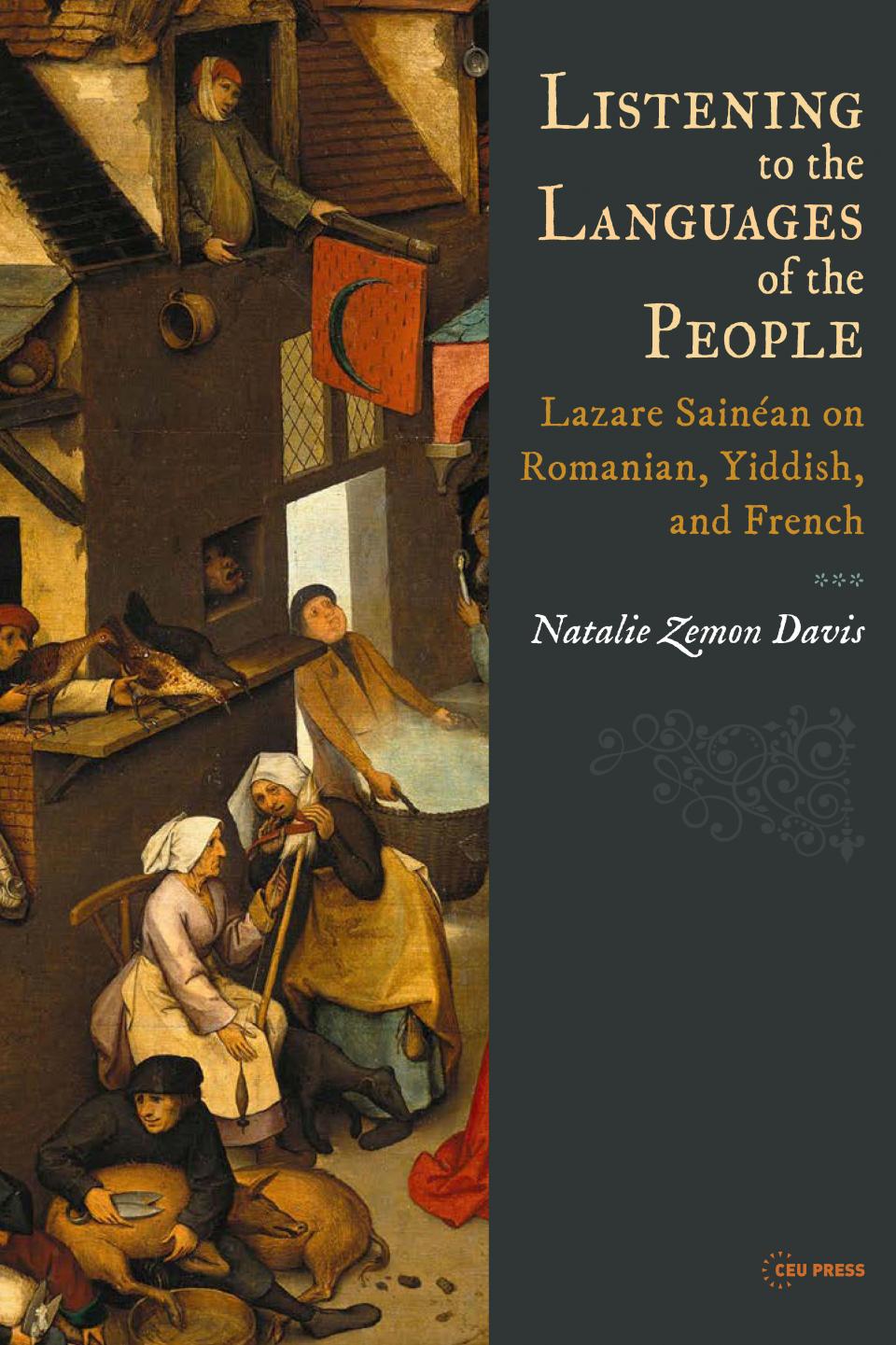
Natalie Zemon Davis, Listening to the Languages of the People: Lazare Sainéan on Romanian, Yiddish, and French. Budapest, Vienna, New York: CEU Press, 2022.
Book under preparation in SRS’s Polirom series
(The Romanian translation will be published with the support of the “Elie Wiesel” National Institute for the Study of the Holocaust in Romania)
This tale of great achievements and great disappointments offers a fresh perspective on the interplay between scholarship and political sentiment in the late nineteenth and early twentieth centuries. (From the webpage of CEU Press)
“Once again, Natalie Zemon Davis has given us a beautifully written and meticulously researched study illuminating a historical period through the story of one individual. Lazare Sainean (1859–1934)—philologist, folklorist, Jew, convert, scholar of Rumanian, French, and Yiddish—was repeatedly denied citizenship and academic positions and yet, as Zemon Davis convincingly argues, was able to cross cultural and geographic boundaries.” (Anita Norich, University of Michigan)
“Romania has been on the fringes of Yiddish research until now. A new book by Natalie Zemon Davis shows that one of the very first studies of Jewish dialects was published in Romania at the end of the 19th century. Her book “Listening to the languages of the people: Lazar Sainean on Romanian, Yiddish, and French” tells the dramatic life story of an important Romanian philologist of Jewish origin, who made an important contribution to Jewish linguistics.” (translated from Yiddish) (Michael Krutikov, University of Michigan, in Forward)
“In her last book, Natalie Zemon Davis takes on the multifaceted life of a linguist and philologist born in Romania, who died in Paris, as a window into the survival strategy of Jewish intellectuals in the face of antisemitism in Europe at the end of the nineteenth century. In her well-honed technique of biographical inquiry and storytelling, she brings to life the aspirations and disappointments, the passion and sorrow of someone who deserved better than he got. That is the perspective Zemon Davis presents in this empathetic portrait of Eliezer ben Moses Șain, later Lazar Șăineanu, and finally Lazare Sainéan in the last decades of his life.” (Maria Bucur, Indiana University, in Hungarian Studies Review)
“This book is the final intellectual legacy of the renowned historian Natalie Zemon Davis (1928-2023), often identified as a pioneer of microhistory. Zemon Davis’s latest publication reaffirms her exceptional talent for storytelling expressed in the masterly treatment of figures with complex and elusive identities.” (Nicola Perencin, University of Padova, in Journal of Modern Jewish Studies)
“A very important contribution to the study of the history of the Yiddish, Romanian, and French linguistics, of Romanian and general East European and Balkanic folklore, and of the history of the Jews of Romania in the period of the polemics for emancipation in the last two decades of the 19th century. The book is very useful for philologists, folklorists, historians of Romanian Jewry and of Romania.” (Lucian-Zeev Herșcovici)
“Known under the name of Lazăr Șăin, Lazăr Șăineanu (from 1883) and Lazare Sainéan (from 1901), the renowned linguist and folklorist is an interesting addition to Natalie Zemon Davis’s study of figures who crossed cultural and geographical boundaries. This book, which often reads like a novel, emphasizing the author’s qualities as a storyteller, follows one man’s destiny in late nineteenth-century Europe, as one of many Jewish life stories. The book explores identity as constructed by its subject, but also as recast by the historian.” (Maria Silvia Crăciun, Babeș-Bolyai University)
“Davis quotes Sainéan’s own assessment of his situation at the end of his long career: ‘indeed, here, in regard to social relations, I am always still ‘the intruder’. One of the virtues of her book is that she does not seek to hide her subject’s foibles—including a somewhat thin-skinned insistence on his own rightness, a certain defiant self-regard, a pragmatism that didn’t always do him much good. Rather, Davis goes constantly in search of more complex motives behind Sainéan’s scholarly preoccupations and life choices: this renders us a very human figure, whose story serves as a litmus for the atmosphere of the times through which he lived.” (Alex Drace-Francis, University of Amsterdam, in Reviews in History)
“’My life was crossed by so many disappointments’ declared Lazare Sainéan. In a book written with erudite empathy, Natalie Zemon Davis reconstructs the successive disappointments of this extraordinary scholar. Her rigorous and touching work allows us to listen the vigorous and tormented voice of a man who dedicated his intellectual life to encounters, loved two nations and three languages, and, however, remained everywhere a foreigner.” (Roger Chartier, Collège de France and University of Pennsylvania)
“The tragic biography of Lazar Sainéan (1859–1934), entangling different beliefs (Judaism, Christianity, and atheism), different lands (mainly Romania and France) and most importantly, different languages, was recently turned by leading historian Natalie Zemon Davis into a thrilling topic. In yet another impressive global-microhistorical exploration, and once again loyal to the Italian “exceptional normal” tradition she has sparked in the US, Davis uses Sainéan’s account to ponder about the shaping of different social hierarchies from a Jewish perspective.” (Guli Dolev-Hashiloni, Free University Berlin, in H-Soz-Kult)
“There are many gaps and unknowns in Sainéan’s biography, as the linguist wrote only a short memoir and left no personal papers. Either by reconstructing the linguist’s social networks or by tracing his intellectual influences, Zemon Davis fills the blank spaces with great accuracy and helps us understand how transfer of ideas and Sainéan’s reflection on identity and sense of belonging evolved. This way Zemon Davis manages to write a biography that can serve as a starting point for the research of modern Jewish history in Romania and beyond.” (Andreea Kaltenbrunner, University of Regensburg, in Quest. Issues in Contemporary Jewish History)
About the author:
Natalie Zemon Davis (1928–2023) was the Henry Charles Lea Professor of History emeritus at Princeton University, where she also served as Director of the Shelby Cullom Davis Center for Historical Studies, and was also Adjunct Professor of History at the University of Toronto. She taught earlier at the University of Toronto and at the University of California at Berkeley. A social and cultural historian of early modern times, she is the author of 200 articles and of nine books, with many of them translated into several foreign languages.
You can find more information about Natalie Zemon Davis here.
Mihaela Șerban, Subverting Communism in Romania: Law and Private Property 1945-1965. Lanham: Lexington Books, 2019
Book under preparation in SRS’s Polirom series

“Subverting Communism in Romania explores the role of law in everyday life and as a mechanism for social change during early communism in Romania. Mihaela Șerban focuses on the regime’s attempts to extinguish private property in housing through housing nationalization and expropriation. This study of early communist law illustrates that law is never just an instrument of state power, particularly over the long term and from a ground-up perspective. Even during its most totalitarian phase, communist law enjoyed a certain level of autonomy at the most granular level and consequently was simultaneously a space of state power and resistance to power.” (From Rowman & Littlefield’s webpage)
“Mihaela Şerban makes a compelling argument that communist legality in socialist East and Central Europe should be equally understood as an instrument of state repression and a space for continuity, accommodation, and subversion. This argument is sustained by a rich documentation of historical and archival sources and interviews relating to the nationalization and expropriation of housing in the Banat region of Romania during the first two decades of the communist regime between 1945-1965. […] The monograph has broader implications for the complex relationships between any legal system and its subjects in a non-democratic society. Its sophisticated conceptual approach makes it an important source for a large academic audience including scholars of socialism and post-socialism, of law and society and of transitional justice.” (Monica Ciobanu, State University of New York at Plattsburgh)
”Mihaela Șerban argues that the nationalization of urban housing in early communist Romania offers a unique view into the strategies deployed by the new communist regime to consolidate its power. Drawing on a rich collection of archival material, which Șerban discovered in the regional archives of Timișoara in western Romania, the book tells a very important story. This is a story of negotiation of power, capital, and the economic and symbolic value of houses as a particular form of property. Șerban draws on a wide range of theories as well as meticulous research, grounded in a critical reading of the laws dealing with nationalization, as well as a vast collection of case studies, revealing an incredible array of life histories captured by hundreds of petitions. She offers us not only a sharp and very well-written history of the uses and abuses of law in early communist Romania, but also the most detailed and theoretically sophisticated account of the nationalization process in Romania (published so far).” (Emanuela Grama, Carnegie Mellon University)
“Șerban tells an unexpected and previously unknown story of resistance to the nationalization of their homes by ordinary Romanians in the 1950s. She weaves her meticulous archival research into an engaging and theoretically compelling narrative of the ups and downs of the campaign to reshape legal consciousness in the image of Marxism-Leninism. The endless petitions by displaced Romanians to have their rights reinstated demonstrate not only that law mattered, but also their continued belief in private property. Serban’s book fills a nagging gap in the literature and deserves to be widely read.“ (Kathryn Hendley, University of Wisconsin)
”In this six-chapter book, Mihaela Serban offers a nuanced perspective of the manifold ways in which legal continuity and change affected the takings of homes during early communist rule in Romania. With the help of newly discovered archival documents she studied in Timişoara, Serban shows that during the 1945-1965 period law was more than an instrument of violence and repression blindly used by a dictatorial regime to effect social change and unmake the pre-communist hegemony of private property. […] A carefully researched and elegantly written analysis showing profound understanding of Romanian realities, this book is a necessary reading for all those interested to know more about the property regime, the legal culture, and the interplay between power and law in an understudied country of the former communist bloc.” (Lavinia Stan, St. Francis Xavier University)
About the author:
Mihaela Şerban is Professor of Law and Society at Ramapo College of New Jersey. She joined Ramapo College after earning law and graduate degrees from the University of Bucharest (Romania), Central European University (Budapest, Hungary), and New York University, and working for the Ford Foundation and the New York University School of Law. As a multi-disciplinary scholar, she focuses on the complex nature of law in society, the way it is both shaped by and itself shapes society. Her teaching and publications are in the areas of law and society, human rights, the rule of law, and memory studies. Her most recent publications include “Law as Mnemonic Infrastructure: Archival Legal Discourses and Memory Battles in Romania,” in the Journal of Law, Culture and the Humanities (2024), and “Are We There Yet? Romania’s Semi-Peripheral Rule of Law,” in Lavinia Stan and Diane Vancea (eds.), Post-Communist Progress and Stagnation at 35: The Case of Romania (Palgrave Macmillan, 2024). She is currently co-editing a volume, with Monica Ciobanu, entitled Between the Memory and Post-Memory of Communism in Romania: Fluid Memories (Routledge, forthcoming).
You can find more information about Mihaela Șerban here.